Explore the science
What is a drone?
Drones, their types and their parts
A drone is an aircraft with no pilot riding inside it. That does not mean there is no person responsible for its flight, and it does not mean every flight is autonomous. A person can control a drone remotely, or a flight controller can carry out a planned task. Start by asking who is giving instructions and where that person is. This is more useful than deciding from size or appearance alone.
The first activities in this topic move from recognising aircraft to understanding a complete system. Is it a drone? asks students to sort flying things and explain their choices. Pick the right drone compares multirotor, fixed-wing and VTOL designs through different jobs. A design that suits a long mapping route may be a poor choice for holding position beside a structure. The important question is what the aircraft needs to do.
Build a quadcopter turns a list of parts into an assembled machine. The frame holds the parts in relation to one another. Motors and propellers produce thrust. The battery supplies energy, and the flight controller coordinates the motor commands. These parts cannot be understood entirely in isolation: changing one part changes what the others must support, power or control. Ask students to explain a connection between two parts as well as naming them.
A drone is a system separates the path of electrical power from the path of instructions. The battery does not decide which way to turn, and a command signal does not itself supply all the energy that turns a propeller. Removing a connection provides a prediction task: which part stops receiving power or information, and what behaviour should change? Students can then compare their explanation with the simulation.
For younger learners, use the poster and screenshots to build a shared vocabulary before opening an activity. Older learners can draw a system diagram with separate arrows for power and commands. Finish with a job-selection discussion that includes both the benefits and limits of the chosen aircraft. The goal is a reasoned design choice, rather than a claim that one type of drone is best for every task.
What is a drone?
Drones, their types and their parts
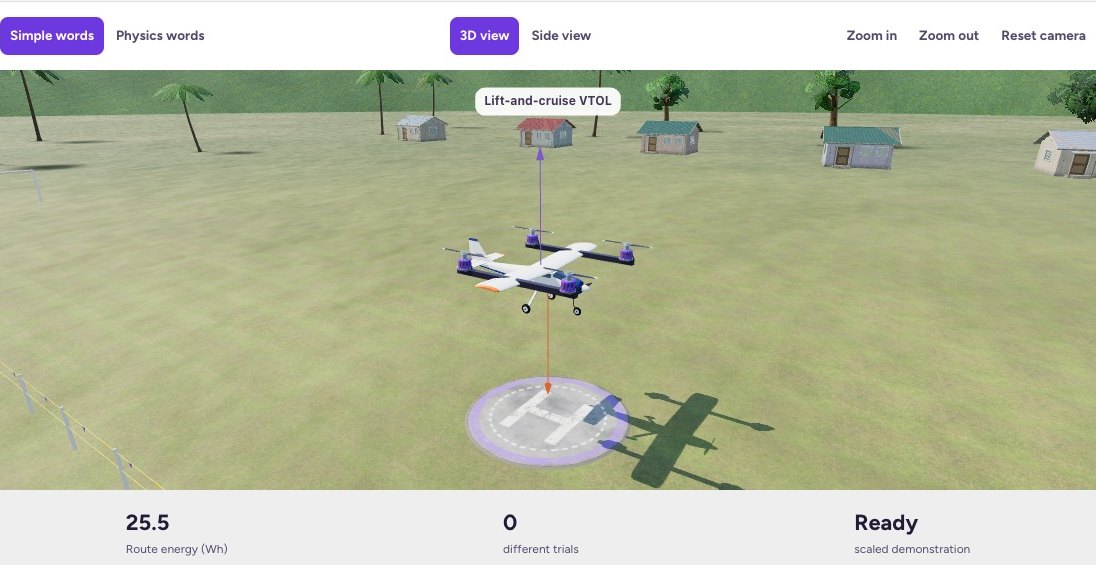
Four aircraft, one mission
Compare energy and landing needs
Grades 3–6 · Grades 7–8 · Grades 9–11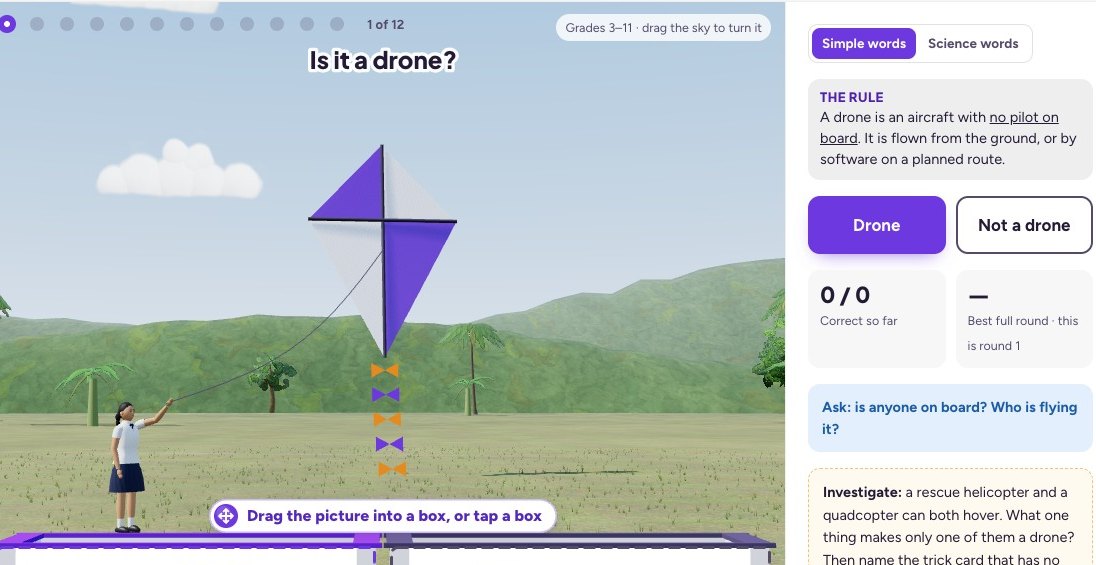
Is it a drone?
Sort 12 flying things
Grades 3–6 · Grades 7–8 · Grades 9–11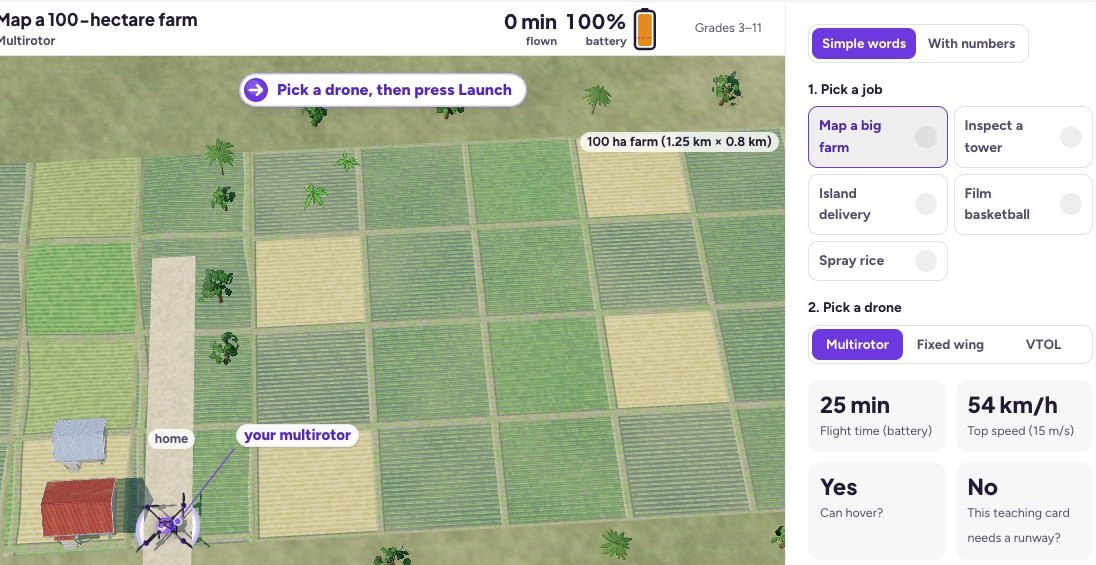
Pick the right drone
Multirotor, fixed wing or VTOL?
Grades 3–6 · Grades 7–8 · Grades 9–11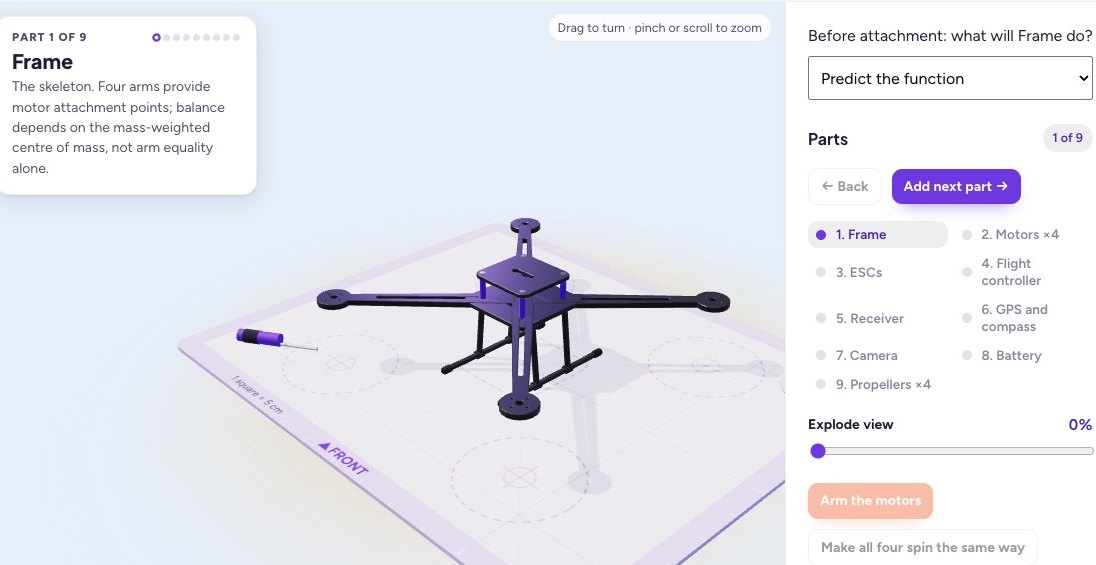
Build a quadcopter
Parts of a drone · 3D
Grades 3–6 · Grades 7–8 · Grades 9–11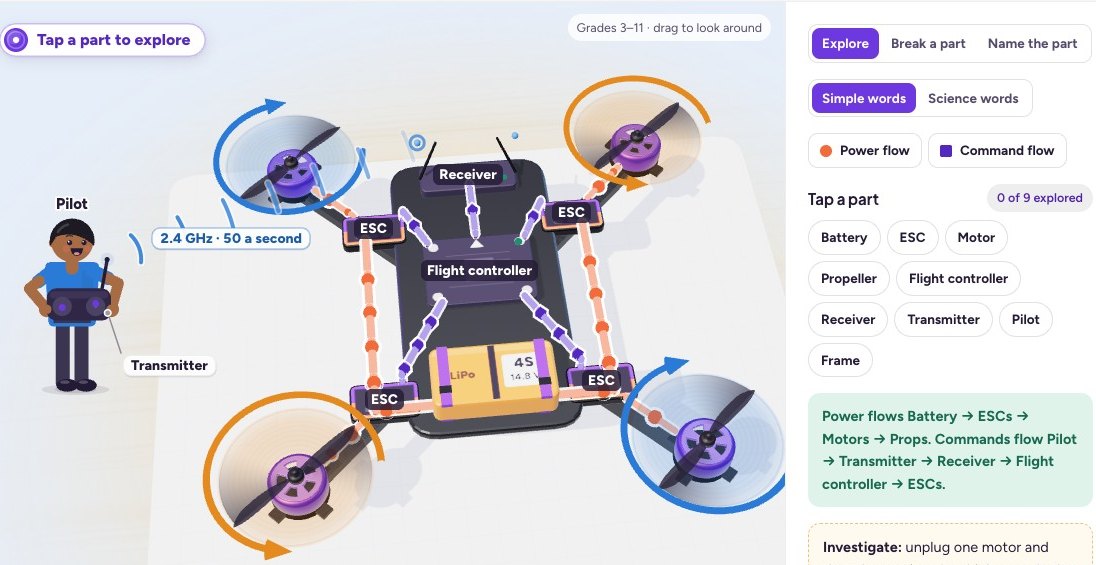
A drone is a system
Power one way, commands the other
Grades 3–6 · Grades 7–8 · Grades 9–11Questions about what is a drone?
Does a drone have to fly itself?
No. Uncrewed describes where the pilot is; autonomous describes how a task is carried out. Remote control and autonomous operation are different ideas.
Why are there different drone shapes?
Different tasks need different abilities. Compare holding position, covering distance, carrying a load and taking off from a small area.
How teachers use the labs
Start with the public explanation and ask students to predict what will happen. Compare the preview with that prediction, then sign in to change the controls or run a program. Ask pairs to record one change and explain its effect using the science or programming concept on the page.
Run them with a class
Read the grade bands and teaching connections, choose one activity, and share its preview with students. The description is public; opening the interactive activity requires a free account.